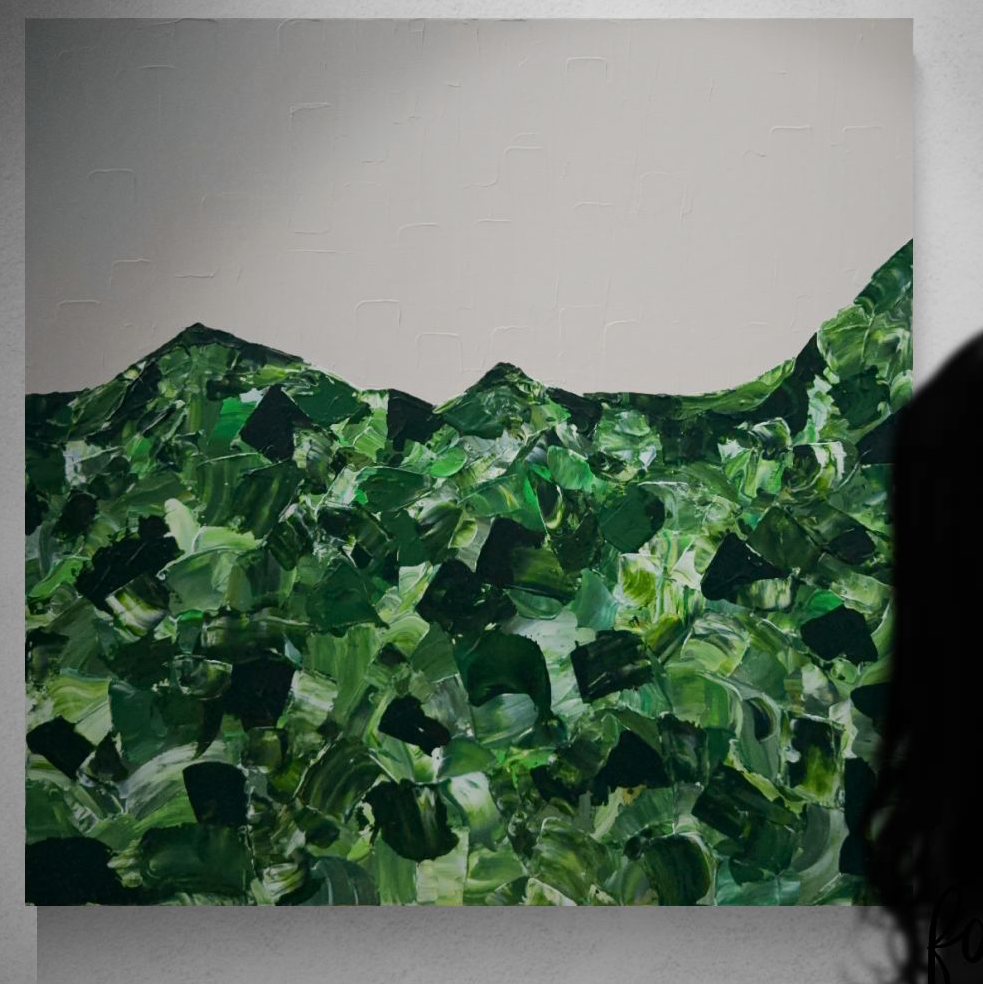
In January I drove to a farmhouse in a forest and painted only greens for fourteen days. This was not a retreat in the spiritual sense — though it became one. It was an experiment in limitation.
What happens to your eye, and your hand, when you remove everything except one colour family and give it your complete attention?
The farmhouse had a large studio with north-facing light — the painter's light, cool and consistent, the light that does not flatter and does not lie. There were no distractions. There was a wood-burning stove, a kitchen, a bedroom, and a room I turned into a studio by moving out the furniture and laying canvas on the floor.
On the impossibility of green
Green is the most difficult colour in painting. This is a known fact among painters, spoken with the particular weariness of people who have been defeated by it many times. The problem is that green exists in nature in an almost infinite range of values, temperatures, and saturations — but the same range, on a canvas, tends toward monotony or sickness.
Natural greens shift constantly. The green of a leaf in morning light is a different green from the same leaf at noon. The green of moss is not the green of grass is not the green of lichen. And all of them, in painting, risk becoming the same dead middle value if you are not careful.
After four days of painting only green, I stopped seeing green as a colour and started seeing it as a field of relationships. The green on the canvas was never just green. It was warm against cool, deep against pale, saturated against muted.
The palette of the residency
I brought viridian, sap green, chromium oxide, phthalo green (yellow shade), and two mixed greens prepared before leaving. I brought raw umber, yellow ochre, and titanium white — the neutrals that allow you to cool, warm, or desaturate without leaving the family. No blue and no yellow. I wanted to see if I could build an entire world from the greens alone.
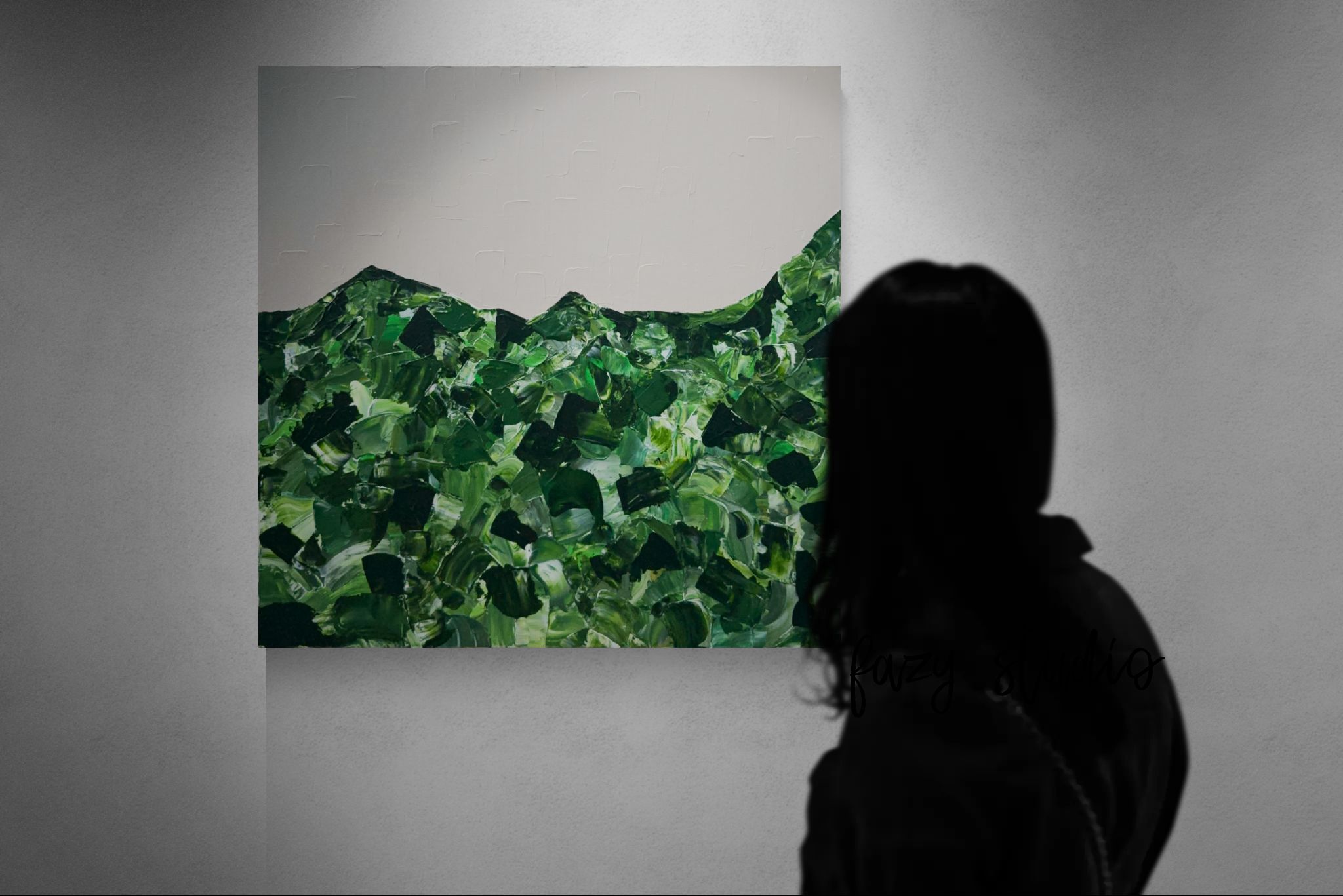
By day five, chromium oxide had become my anchor colour. It is an opaque, slightly grey-green — muted, earthy, very stable. It does not vibrate. It sits. In a painting of competing energies, chromium oxide is the quiet room you retreat to. Emerald Mountains, the largest work from the residency, is built almost entirely on a ground of chromium oxide, with viridian and phthalo providing the movement above it.
What I brought home
Fourteen paintings in fourteen days is not the right way to think about what I made. Some were abandoned before lunchtime. Some were painted over. What I brought home was a set of four finished works and a completely rearranged understanding of green.
The Thicket works — named after the feeling of being in dense vegetation, surrounded by overlapping greens at every depth — are the most atmospheric paintings I have made. They do not contain identifiable forms. They do not depict forest or field. But people who have seen them in person consistently describe them as spatial: rooms you could step into, places with weather and light of their own.
Three works from the Thicket residency are currently available. If you would like to know more, or to discuss a commission in the green palette, please get in touch.